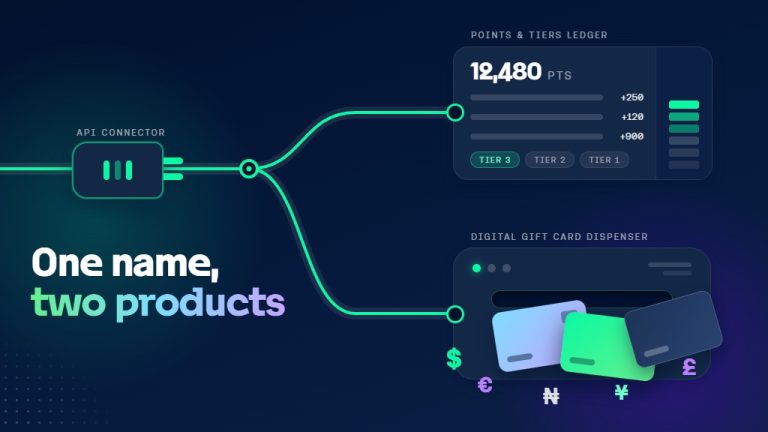

A determined platform publishes 200 million reward options across 100 countries and 130 currencies. It does not own them. Employee recognition platforms source almost none of their catalog directly: they buy access from reward infrastructure providers, then curate, localize and route what those suppliers already carry. A recognition catalog is assembled, not owned.
That is not a criticism of anyone. Negotiating with thousands of merchants across dozens of markets is a business in itself, and it is not the business a recognition platform is in. But it does mean the headline number on a platform’s marketing page belongs to somebody further down the chain, and the handful of suppliers behind a large recognition catalog are what decide which employee in which country can redeem what.
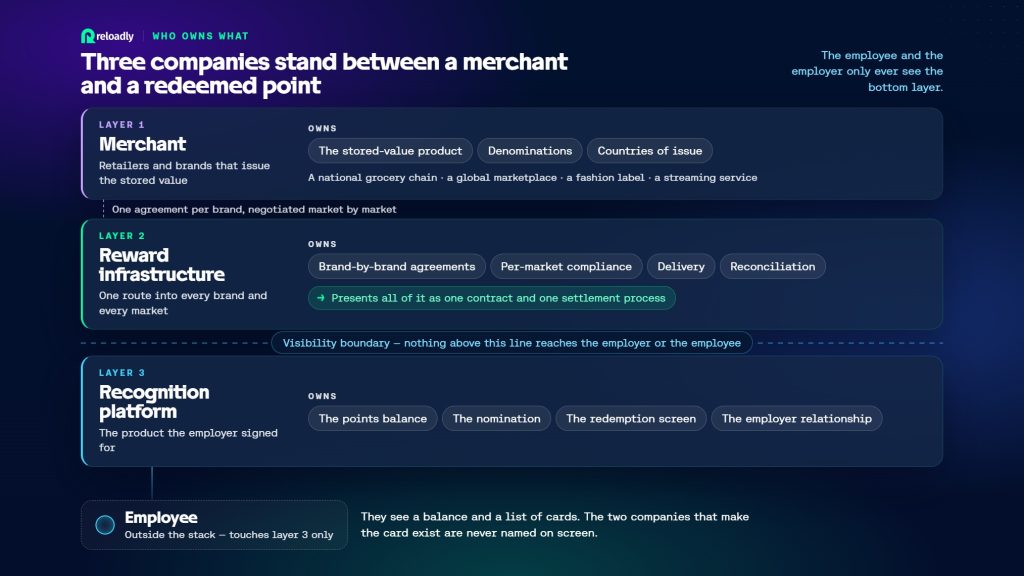
The three layers behind every redemption
Three distinct layers sit between a merchant and an employee spending points. Each one owns a different part of the problem, and confusing them is why catalog conversations go in circles.
The merchant issues the card
A gift card issuer is a retailer or brand that creates the underlying stored-value product, sets the denominations it will sell, and decides which countries it will issue in. Amazon, Zara and Uber sit here.
Merchants rarely sell one card at a time to a recognition platform. They sell through distribution, in volume, on commercial terms that assume a partner who can move inventory. A recognition platform serving a few hundred employers is rarely big enough to interest most merchants directly, which is why the second layer exists.
The reward infrastructure provider aggregates it
Reward infrastructure is an API layer that aggregates stored-value products from many merchants and markets and exposes them to other platforms as a single catalog with one contract and one settlement process. Reloadly, Tango Card, Tremendous, Tillo, Runa and Giftbit all operate here.
This is the layer that does the unglamorous work: brand-by-brand agreements, per-market compliance, denomination ranges, delivery, and reconciliation. What a recognition platform buys from this layer is not really a catalog, it is the ability to stop having those conversations.
The recognition platform routes and presents it
A recognition platform is the software an employer’s people actually see: the points balance, the nomination, the anniversary email, and the redemption screen. Bonusly, Achievers, Workhuman, Nectar and Awardco sit here.
Why one brand is not one product
One gift card brand becomes many purchasable products, because a product is one brand in one country at one denomination range in one currency. This is the single most useful thing to understand about a reward catalog, and almost nobody states it plainly.
Reloadly carries 1,000+ brands and 14,000+ gift card products. Those two figures describe the same catalog and they are fourteen times apart. A brand issued only in the United States produces a handful of products. A brand issued across thirty markets produces dozens.
So brand count tells you very little on its own. Say your platform’s catalog lead is asked whether you can cover a customer’s team in Germany. The brand count answers nothing, and the product list for Germany answers it immediately.
Working out which unit a vendor is quoting is most of the evaluation, and we covered the rest of that assessment in what to look for in a rewards infrastructure provider.
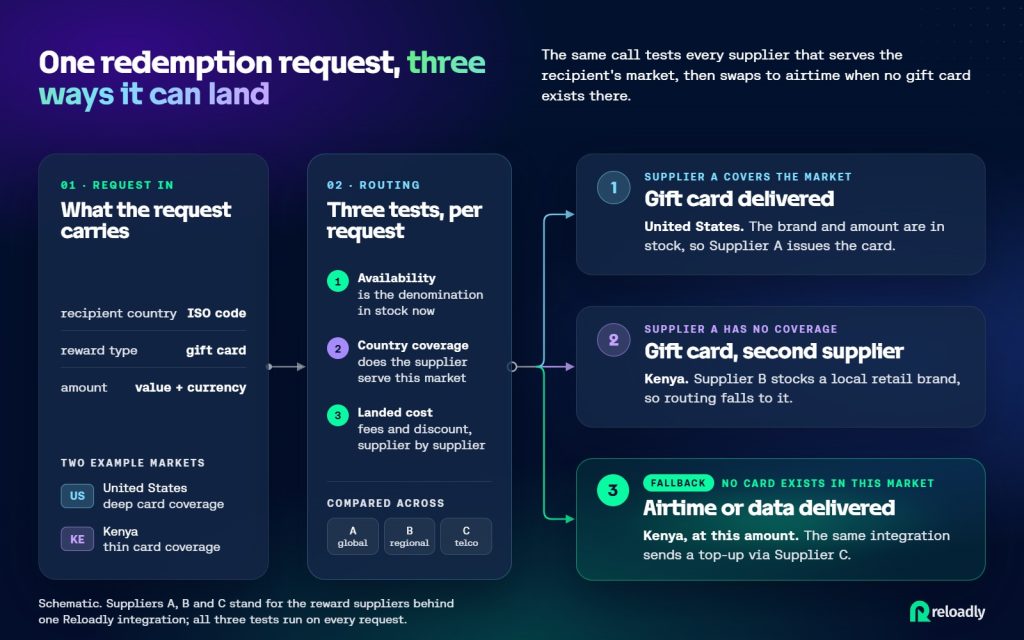
How do platforms route a redemption between suppliers?
Larger recognition platforms integrate several reward suppliers and choose between them per redemption, based on the recipient’s country, the reward type, availability and cost. The routing layer is invisible to the employee and it is where the engineering sits.
Reloadly delivers into 150+ countries and 100+ currencies through one integration, which is the kind of footprint a routing layer is built to draw on. A platform holding two or three suppliers is asking a different question at redemption time: not “do we have Amazon”, but “do we have anything this person can use, today, in their currency”.
Take a concrete case. Your employer customer has 40 people in Lagos and 300 in Manila. Your catalog shows Amazon, because the catalog is global. Neither group can redeem it in a way that feels like a reward. A catalog that is broad globally and thin locally reads to the employee as a broken benefit, not as a generous one.
What happens where gift cards do not reach?
In markets with little or no gift card coverage, the alternatives are mobile airtime, data bundles, utility bill payments and cash-equivalent prepaid cards, and these run on completely different supply chains from gift cards. This is the question every catalog lead gets asked and the one the category answers worst.
Reloadly delivers gift cards, airtime, data and utility payments through one API, which means a market with no card coverage does not require a second integration or a second vendor relationship. That is a category-specific capability rather than a general one, and it matters most in exactly the markets where a recognition program looks weakest.
The practical effect is narrow but useful. A recognition platform that can send a data bundle where it cannot send a gift card keeps its redemption rate in the markets that would otherwise drag it down.
What does the reward supply chain cost?
Every layer in the chain takes margin, and the recognition platform’s cost of goods is set by the supplier terms it negotiated rather than by the face value of the card. Very few providers publish anything about this, which is why the one that does is worth reading.
The commercial pressure behind all of this is going one way. Mordor Intelligence puts corporate buyers of gift and incentive cards on a 10.09 percent compound annual growth rate to 2031 and digital formats on 13.45 percent, in research published on 17 June 2026. The corporate, digital corner of this market is the fastest part of it, and it is the corner a recognition platform sells into.
Where a single integration still has limits
Consolidating onto one reward supplier does not remove per-country brand gaps, and it concentrates the risk of an outage into a single relationship. Any provider suggesting otherwise is describing a catalog that does not exist.
Three limits are worth planning around. Denomination ranges differ by market, so the same brand is not always sellable at the same values. Local brand preference is real, and a globally famous brand is often not the one a recipient in that market wants. And a supplier-side incident affects your whole catalog at once rather than one brand, which is the trade for the simplicity.
Peaks are where this shows up first. Year-end and service-anniversary spikes push volume through the same suppliers at the same moment, and the mechanics of holding that up are covered in delivering at volume without manual ops.
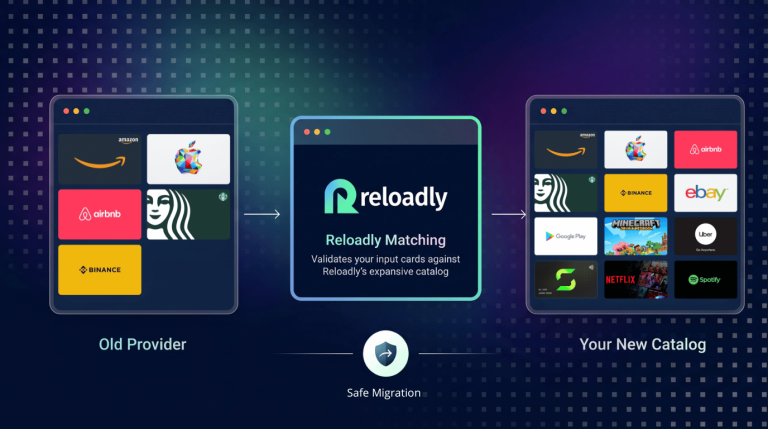
None of this is an argument against consolidating. It is an argument for testing a supplier’s coverage against your real redemption mix before you migrate, which is the same discipline that makes switching providers survivable.
Mordor Intelligence puts Asia-Pacific as the fastest-growing region in the same June 2026 research, at 10.23 percent annually. Those are markets where the gap between a global catalog and a local one is widest.
So the honest answer to where the rewards come from is that they come from two or three companies you have never marketed to your customers, and the quality of your program is largely their coverage, priced and presented as yours.