
A research incentive is a payment for a person’s time in a study. When one study runs in several countries, set each country’s amount from what that time is worth there. Scale your home-market amount by local prices, but never below the smallest reward people there can use. Pay it in the local currency, in a form they use.
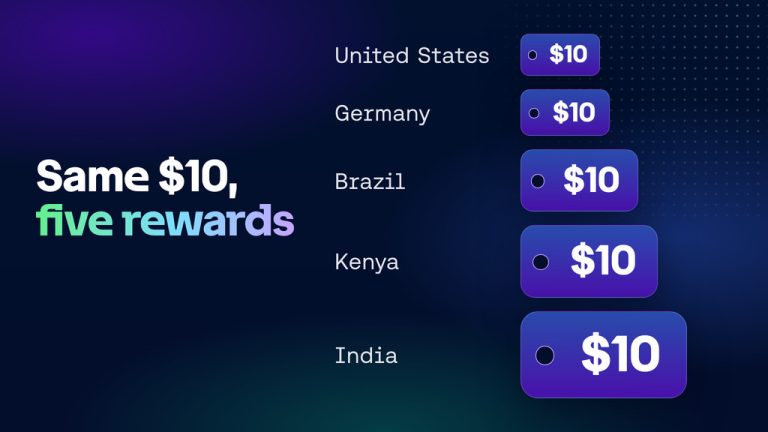
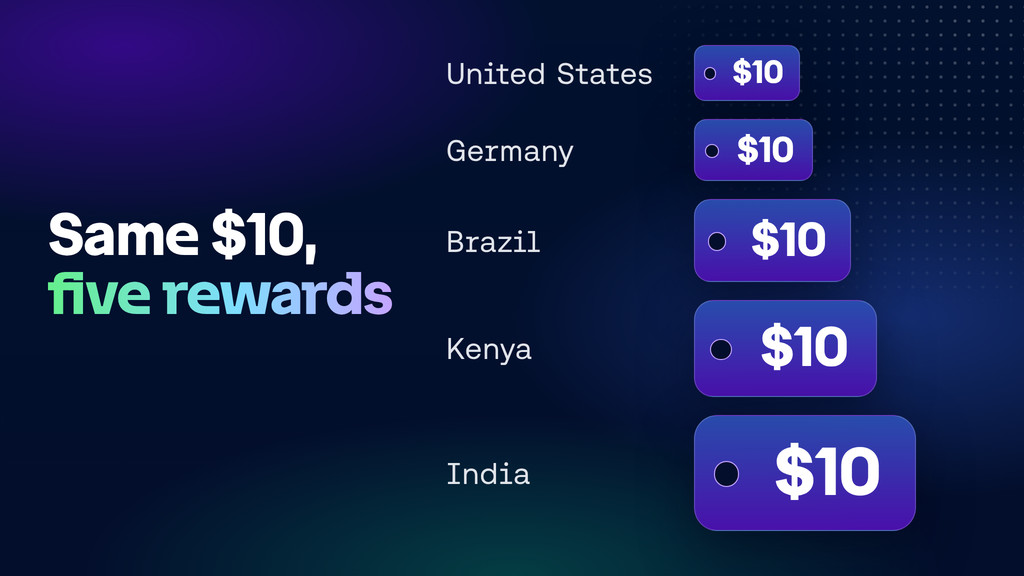
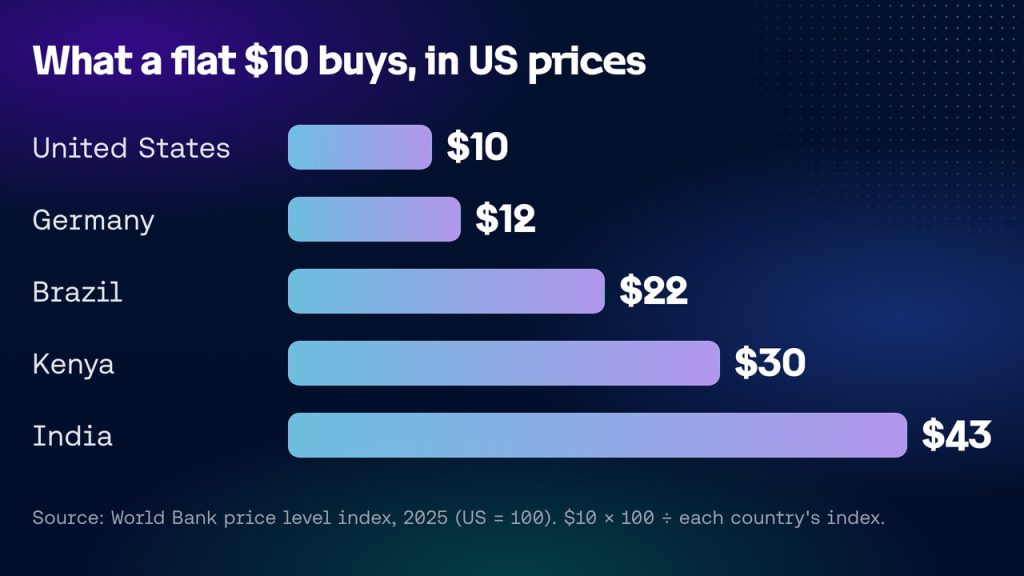
Pay everyone the same dollar amount, and the same 20 minutes earns very different rewards depending on where a person lives. Prices are the reason. The World Bank’s price level index shows how many US dollars it takes to buy the same things in each country. The United States is set at 100. The index’s 2025 figures put Germany at 80.2, Brazil at 45.7, Kenya at 33.7 and India at 23.0.
So $10 in India buys about what $43 buys in the United States. This page shows how to turn that gap into a fair amount for each country, on one worked example.
What is a research incentive?
A research incentive is a payment that a research team gives a person for taking part in a study. In a survey, the respondent is the person who answers the questions. The payment is usually small and digital, such as a gift card code or credit added to a phone.
Most teams budget per complete, which is one finished survey that passes the team’s quality checks. Fieldwork is the stretch of weeks when the survey is live and collecting answers, and it is when the incentives go out.
Picture a research agency, the example agency, running one 20-minute online survey in five countries: the United States, Germany, Brazil, India and Kenya. It needs 400 completes in each, 2,000 in all. At home in the United States, it pays $10 a complete. The question is what it should pay in the other four, and the easy answer is $10 everywhere.
Why one US-dollar rate breaks across countries
One US-dollar rate paid in every country gives respondents very different rewards for the same time, because prices differ from country to country. The example agency’s flat $10 would cost $20,000 for 2,000 completes. In Germany, that $10 buys about what $12 buys in the United States. In Brazil it buys about $22 worth, in Kenya about $30 and in India about $43.
That gap matters because a reward is an offer, and a survey run in five countries should make the same offer in each. The example agency asks for the same 20 minutes everywhere. With a flat $10, the offer behind those minutes is more than four times stronger in India than in the United States. A flat rate turns one survey into five different offers. The fix is to set each country’s amount from its own prices, so every country gets the same offer.
How do you set a research incentive for each country?
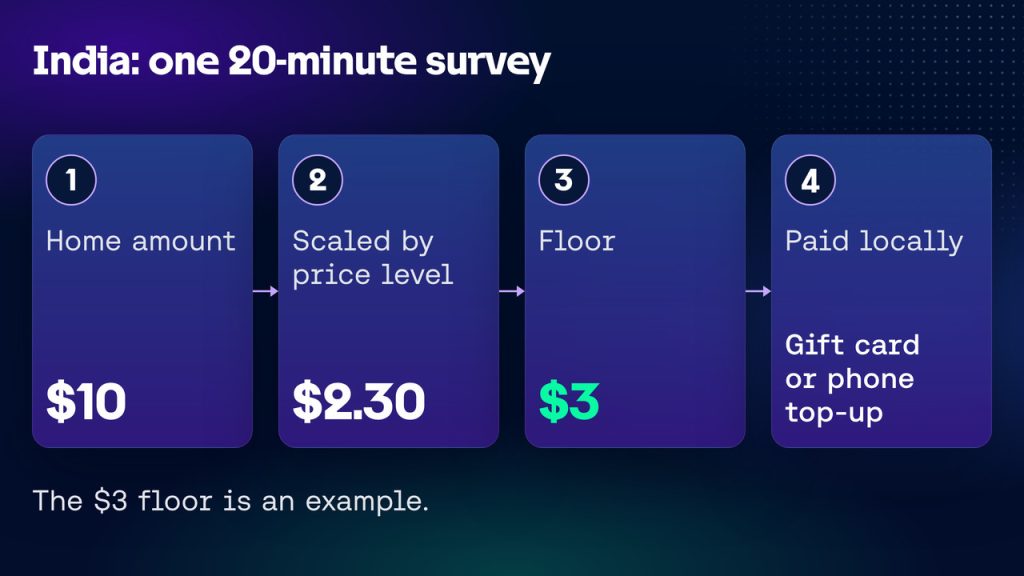
A research team sets a research incentive for each country by starting from one home-market amount and scaling it by that country’s price level. The method takes four steps:
- Set the home amount. Choose what you pay in the market you know best, based on the minutes you ask for. The example agency pays $10 for 20 minutes in the United States.
- Scale by price level. Multiply the home amount by the country’s price level index, then divide by 100. If your home market is not the United States, divide by your own country’s index instead.
- Check the floor. Compare the result with the smallest reward a respondent in that country can still use, and pay whichever is higher.
- Pay it locally. Send the amount in the local currency, as a reward people there already spend.
For the example agency, step 2 gives these amounts:
| Country | Price level, 2025 (US = 100) | Amount per complete | Cost of 400 completes |
|---|---|---|---|
| United States | 100.0 | $10.00 | $4,000 |
| Germany | 80.2 | $8.02 | $3,208 |
| Brazil | 45.7 | $4.57 | $1,828 |
| Kenya | 33.7 | $3.37 | $1,348 |
| India | 23.0 | $2.30 | $920 |
| All five | $11,304 |
Scaled this way, the 2,000 completes cost $11,304 instead of $20,000. Every respondent gets the same buying power for the same 20 minutes. But an amount like $2.30 raises a fair worry: is it too small to be worth anything?
What if the local amount is too small to use?
A research incentive needs a floor, which is the smallest reward a respondent can still use in their own country. The scaled amount is where the math starts. Gift cards and phone credit come in set values, and a reward too small to spend is no reward at all.
Say the smallest gift card that respondents in India are glad to use is worth $3. Then the example agency pays $3 there instead of $2.30. India’s 400 completes now cost $1,200, and the five-country total rises from $11,304 to $11,584. When the scaled amount falls below the smallest usable reward, pay the smallest usable reward.
That leaves one question a finance lead is likely to ask: is it fair to pay people in different countries different amounts?
Is paying a different amount in each country fair?
Paying a different amount in each country is fair when every respondent gets the same buying power for the same time. Research ethics guidance points the same way. The international ethical guidelines from CIOMS, the Council for International Organizations of Medical Sciences, were written with the World Health Organization in 2016 for health research. They say pay for a person’s time should use the minimum hourly wage in the region or country as its reference.
The same guidelines ask ethics committees to judge payment against the local social and economic setting. A local reference is the rule there, and one global figure is not.
The flat rate is the uneven one. It pays the same 20 minutes at more than four times the buying power in India as in the United States. A fair amount still has to reach people in a form they can spend, though.
Pay it in a form people use where they live
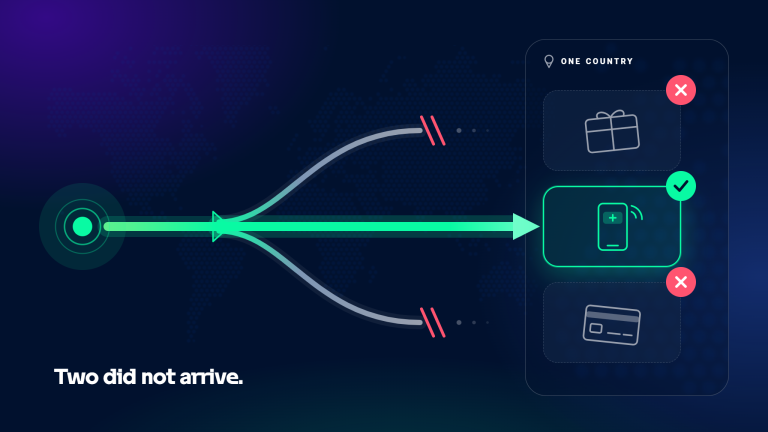
A research incentive works only when it arrives in the local currency, in a form the respondent already uses. A $3.37 reward in Kenya is worth little as a gift card for a shop with no branch there. It has to arrive as something people in Kenya already spend.
For many people, the most usable form is credit on their phone. The World Bank’s Global Findex 2025 was published in July 2025. It counts about 900 million adults who own a mobile phone but have no financial account at a bank or a mobile money service. An airtime or data top-up adds calling time or mobile data straight to a phone number, so it reaches people a card cannot.
Reloadly delivers gift cards, airtime, data and utility payments through one API, a connection that lets one program ask another to do something. Here, the example agency’s survey software asks Reloadly to send a reward. So one connection lets the example agency send a gift card in one country and a phone top-up in another.
Reloadly supports 100+ currencies, so a study is not tied to paying everyone in US dollars. Its gift card catalog carries 1,000+ brands and 14,000+ gift card products, so the reward can also be a brand they know. Where cards do not reach, an airtime top-up does.
Paying in local currencies means money is converted somewhere along the way, and the rate used decides the final cost. The mechanics are in why gift card payouts break across currencies, and how to fix them. Each country now has two settings, its amount and its form, and both need to be fixed before fieldwork opens.
Set each country’s amount before fieldwork opens
A fair research incentive gives the same buying power for the same time, wherever the respondent lives. Set each country’s amount from local prices before fieldwork opens, and check it against the smallest reward people there will use. For the example agency, that means five amounts on one page, from $10 in the United States to $3 in India.
Once the amounts are set, each reward still has to arrive. The steps where that goes wrong are in ten things that break between survey complete and incentive received. If your next study looks like the example agency’s, bring your country list to a demo.