A Chicago research firm is running a shopper study for a national retailer. On Thursday afternoon, its last respondent, a woman in Columbus, Ohio, answers the final question, sees a thank-you screen promising a five-dollar gift card, and closes the tab. For the survey platform, that interview is done.
Getting enough people to say yes is the hardest part of market research. The reward is the main lever, and it only works if people want it and it arrives. When it shows up late, unusable or not at all, the next survey invitation goes unanswered. Most incentive problems end up as participation problems: fewer completed surveys, more complaints, and a pool of willing respondents that quietly shrinks.
What has to happen between thank you and received
A survey incentive is the reward a person is promised for completing a survey: a gift card, a prepaid card, mobile airtime or cash. The people who answer are respondents, and a company’s pool of recruited respondents is its panel. Research teams pay incentives for one reason: people take part when the reward is worth it. A 2023 review of 46 randomized trials in PLOS ONE found that every type of incentive tested raised response rates. Cash lifted them by about a quarter and gift vouchers by about a fifth, compared with offering nothing.
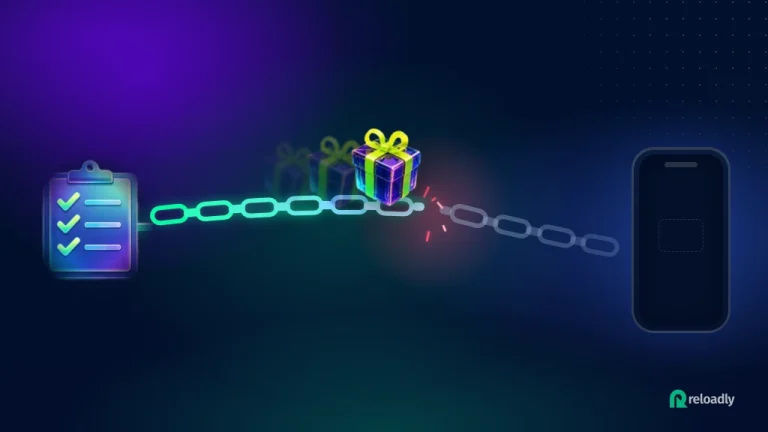
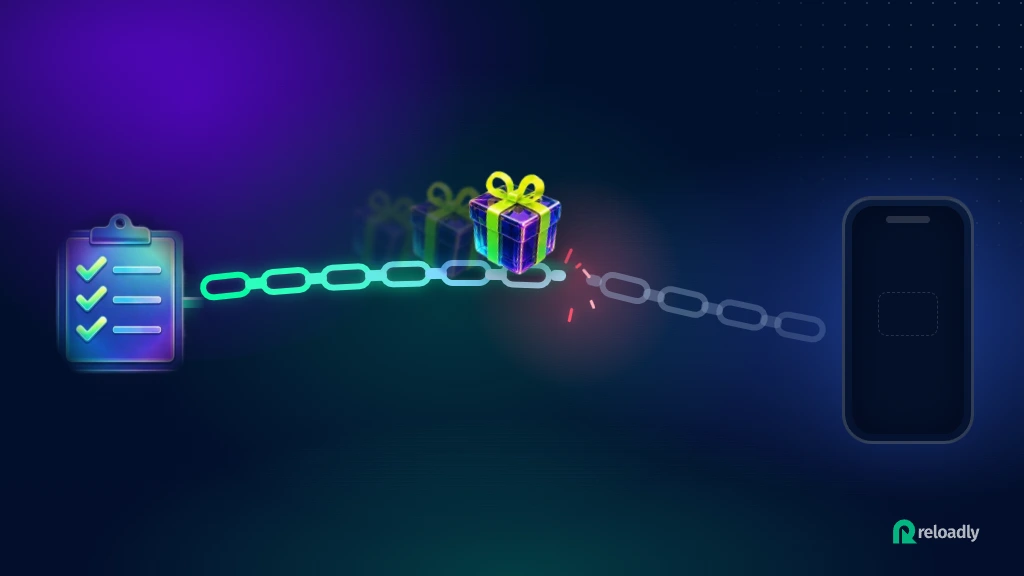
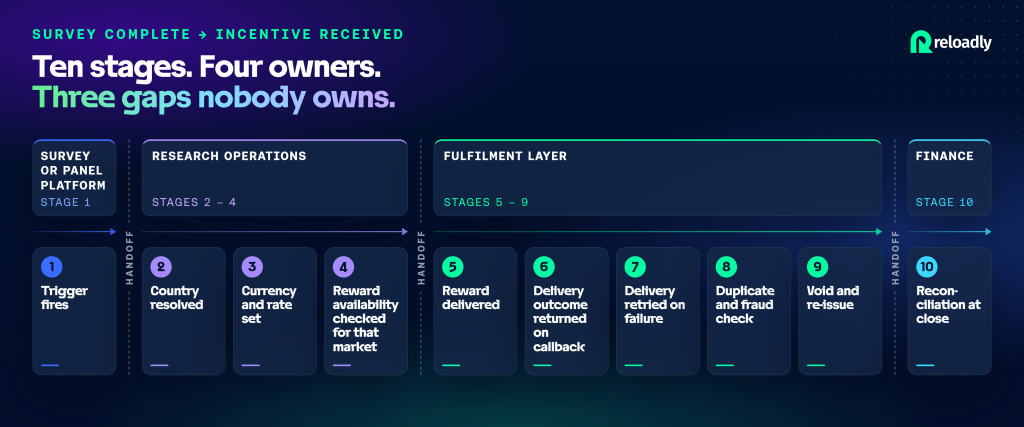
Choosing an appealing reward is only half the job. The other half is getting it to the respondent, and that route crosses four teams. Research operations, the team that runs studies day to day, owns the study. Finance owns the invoice. The survey or panel platform owns the trigger, the automatic instruction to pay that fires when someone finishes. A delivery provider owns the last step: turning that instruction into a reward the respondent can open and spend. No single person in that list sees the incentive travel from one end to the other.
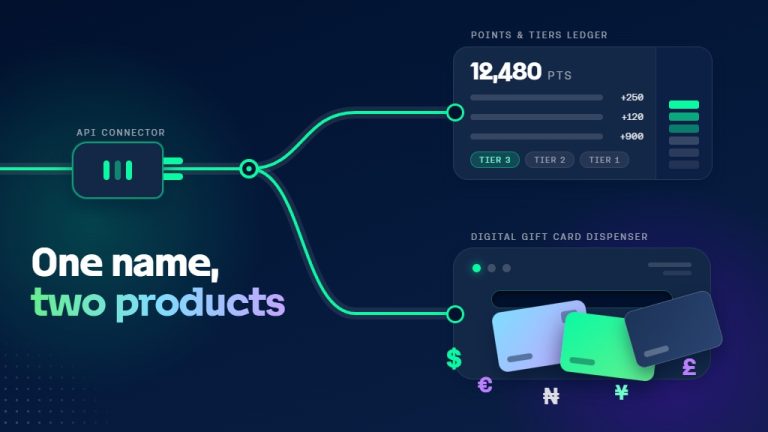
Reloadly is that delivery provider. When a survey platform says “pay this person $5,” Reloadly is what turns it into a gift card in the respondent’s inbox. One way to do that is the Perq Payout Link. Instead of the research team choosing and sending each gift card by hand, every respondent gets a single link and picks the gift card they want from a selection the team sets up. No account or login is needed to redeem it. The respondent gets a reward they chose, and the team sends one link per person whether the study has 50 respondents or 5,000.
Sitting at the delivery end is also why this list exists. It is the one place where a clean survey completion and an unhappy respondent show up as the same event. The stakes are growing: the US insights and analytics industry grew 7.8% in 2025 to $89.3 billion (USD), according to the Insights Association’s 2026 State of U.S. Insights & Analytics Report, published in August 2026. Nearly half of that revenue now comes from technology-led research, so more surveys run on automated platforms. The incentive is the part of the chain automation has touched least, and it is the only thing a respondent ever receives from a study.
What follows is the chain, one failure point at a time, in the order they happen.
1. The reward is paid before the answers are checked
The instruction to pay usually fires the moment the platform marks an interview complete. The quality checks run afterwards, often the next day. They catch people who raced through, ticked the same answer down every column, or typed nonsense into the written questions. By the time an answer set is thrown out, the reward has already gone, and it is far easier to reverse on a spreadsheet than in a respondent’s inbox.
The fix is not clever. It is sequencing: hold the trigger until the quality pass has run, or accept that a known share of incentive spend buys data you will throw away.
2. The country is read from the wrong field
Panels usually store the country a respondent registered from. The survey happens wherever that person is sitting today. For a US study that adds respondents in Canada or Mexico, those are not always the same country, and the reward is almost always chosen from the first one. A reward chosen from registration data rather than from where the respondent lives now is how a payout that looks correct in every record arrives useless.
This collides with a legitimate concern about privacy. Keeping respondents anonymous is a property of the answers. It is not a property of the payment, which has to know where it is going in order to arrive. Teams that treat the two as one thing tend to strip the payout of the only field that would have routed it correctly.
3. The value is fixed in one currency and delivered in another
An incentive budgeted at $5 does not stay $5 once a study crosses a border. It is converted somewhere between approval and delivery, and the question is where. The exchange rate on the day of approval, the day the reward is issued and the day it is spent give three different numbers. Only one of them is the number the respondent was promised on the thank-you screen.
Reloadly settles this by supporting delivery in 100+ currencies, so the reward can be created in the respondent’s own currency rather than converted on arrival. A study running in three markets makes a currency decision in every one of them, and the moment you choose to fix the rate is a study design decision, not a finance detail.
4. The reward exists in the catalog but not in that market
Brand availability is decided country by country. A gift card that works everywhere in the United States may not be sold in Mexico at all, and a catalog that lists it globally is describing the catalog rather than the market.
The Reloadly gift card catalog resolves availability per country across 150+ countries, framed as any country not under sanctions, so the market decides the reward rather than the reward deciding the market. The failure is subtle because nothing errors: a reward is issued, the record looks complete, and the respondent is holding value they cannot spend where they live.
5. The reward arrives and it is the wrong one
Delivery is not the same as value. A reward the respondent does not want, or cannot use in their market or currency, is worth less than its face value to them, and the next invitation feels like less of a deal.
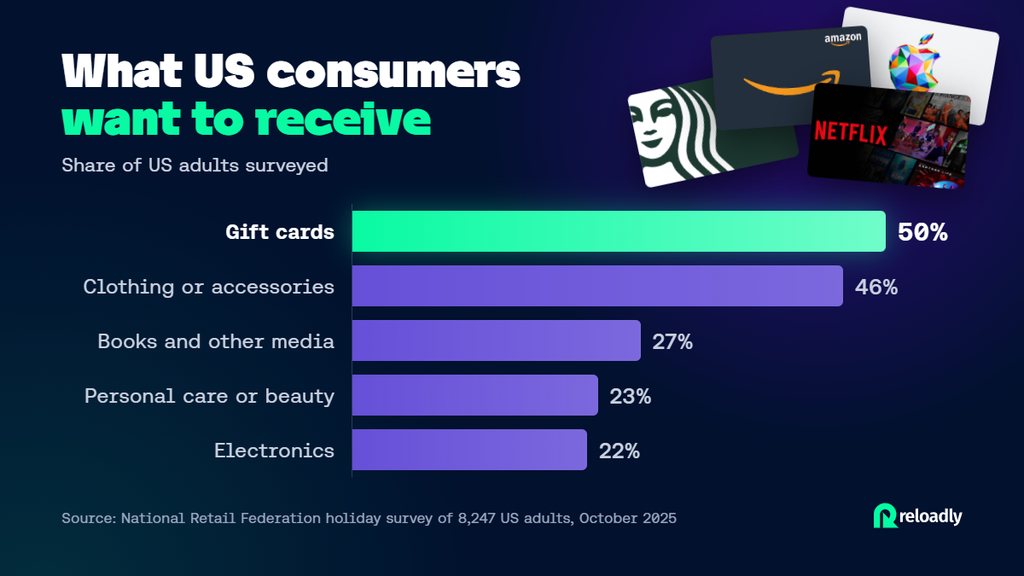
Gift cards are the reward US respondents recognise and want most. In the National Retail Federation’s 2025 holiday survey of 8,247 US adults, gift cards topped the list of gifts people wanted to receive, chosen by 50%. Their appeal is choice: the respondent decides where the value goes.
That appeal only holds when the card fits the person. A $5 card for a coffee chain the respondent never visits is worth nothing to them. The Reloadly gift card catalog spans 1,000+ brands and 14,000+ gift card products. That depth is what lets a team offer a real choice instead of a guess, and the Perq Payout Link hands the choice to the respondent. For respondents outside the US who are easier to reach on a phone than in a store, airtime and data top-ups go through the same integration and can be the more useful reward.
6. Delivery happens later, and nobody reads the result
When a system accepts an order for a reward, it has not delivered one. It has queued one. The result arrives later, as a status callback: a message sent back by the delivery provider saying whether the reward went through. Integrations that record the acceptance and ignore the result are common enough to be worth checking for first. An unread status callback turns every delivery failure into a silent one, discovered at project close instead of within the hour.
The tell is a study where the number issued and the number spent differ by a stable percentage that nobody has ever investigated.
7. The address bounces, and there is no second channel
Email addresses typed by respondents carry typos, full mailboxes, and aggressive spam filtering. When email is the only delivery channel, a bounce ends the chain. The reward sits issued and unclaimed, with no route to the person who earned it, and that person is the one who complains.
A second channel is not a luxury. It is the difference between a failed delivery and a retried one. A text message, a balance inside the panel’s own app, or a link the respondent can reopen all do the job. What does not do the job is a support inbox and a manual re-send process that grows in step with the volume of surveys.
8. One person collects several incentives
Being paid twice is usually filed under finance. It belongs under data quality, because the same gap that pays a person twice is the gap that puts their answers in your dataset twice.
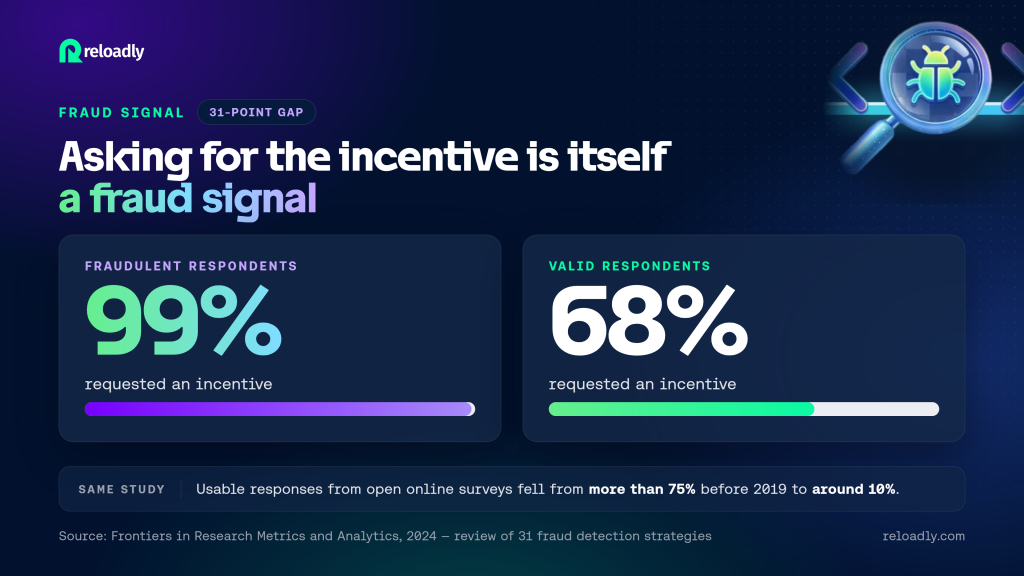
The evidence here is unusually direct. In a 2024 study of 31 fraud detection strategies published in Frontiers in Research Metrics and Analytics, researchers found that 99% of fraudulent respondents requested an incentive, against 68% of valid respondents. The incentive request itself was a stronger fraud signal than most of the dedicated checks the team ran. The same paper reports that 30% of submissions to one survey’s open link were verified as fraudulent. It also reports that usable response rates from open online surveys have fallen from more than 75% before 2019 to around 10% in recent years.
Read that in order. The reward is what attracts the fraud, the request for it is what exposes the fraud, and the delivery step is where you either enforce one payout per verified respondent or you do not.
9. Re-issuing a wrong reward has no clean path
Sooner or later a reward goes to the wrong market, the wrong person or the wrong amount, and the question becomes how quickly it can be cancelled and replaced. Teams discover their re-issue path during their first incident, which is the worst possible time to find out it is a support ticket.
The mechanics matter. Swype Flex, the Reloadly virtual prepaid Mastercard, is single-load today: it is loaded once and cannot be topped up. Correcting a card-based incentive therefore means cancelling the card and issuing a replacement, not adjusting a balance. That is a fact to design the process around, not a detail to discover at project close. Decide in advance who can authorise a re-issue, what evidence they need, and how the replacement is recorded against the original.
10. The numbers do not add up at project close
The last failure is the one everybody recognises. Reconciliation is the check at the end of a study that what was issued, what was spent and what was invoiced all agree. They rarely do on the first pass. The difference is spread across currencies, markets and a survey window that closed three weeks ago.
Three things make this tractable, and all three are decisions taken at the start rather than the end. One reference number that survives from trigger to invoice. Exchange-rate movement reported separately from incentive cost. Unspent rewards treated as a line in the data rather than a rounding error. The same problem in a different industry is worked through in detail in gift card payout reconciliation. Reconciliation is only painful when the identifiers needed to do it were never captured, and by the end of the study they cannot be added after the fact.
What the ten have in common
None of these is a payments failure. Every one of them is a decision that was never assigned. Who checks the answers before the reward moves? Which field decides the market? When is the rate fixed? Who reads the callback? What happens on a bounce? Who can authorise a re-issue?
A research team does not only need a more attractive incentive. It needs the ten handoffs between survey complete and incentive received to have an owner each. Choosing a delivery provider that covers the markets you survey in removes several of these failures outright. The rest are yours, and they are cheaper to assign now than to reconstruct at project close.
Three questions to ask before the next study goes live
Take these to the kickoff meeting, whichever of the four teams you sit in. Is the reward one your respondents want, and can they choose it themselves? Who checks an answer set before its reward is paid, and can the payment wait for them? Who is reading the delivery results while the survey is still open, and what do they do with a bounce? If each question has a name attached, most of the ten are already handled.
If you are mapping this chain for your own studies, Reloadly Research Incentives delivers gift cards, prepaid cards, airtime and data from one integration. Each payout carries a record that reconciles against the study rather than against the month.