
A loyalty program API is an interface that connects a loyalty program to its supporting systems, and the term covers two products: a loyalty engine holding points and tiers, and a reward fulfilment API delivering the gift card. Most teams buy the second, and judge it on catalog depth, coverage, reconciliation, and compliance and switching risk.
What is a loyalty program API, and what does it actually do?
A loyalty program API is an application programming interface that lets a business connect loyalty functions to the systems it already operates, from points ledgers and tier rules through to reward catalogs and delivery.
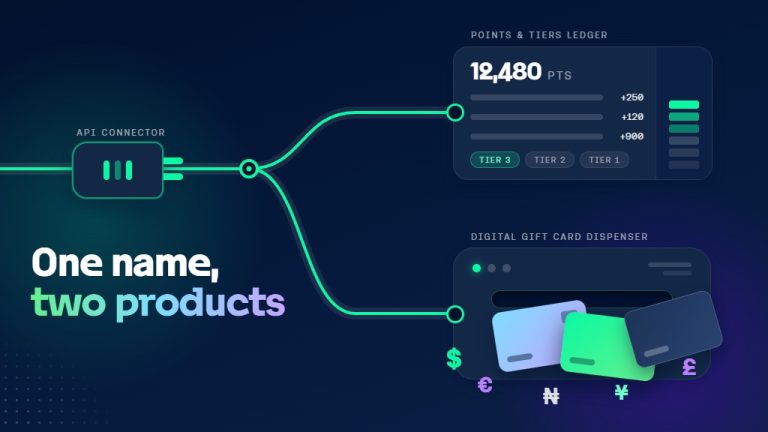
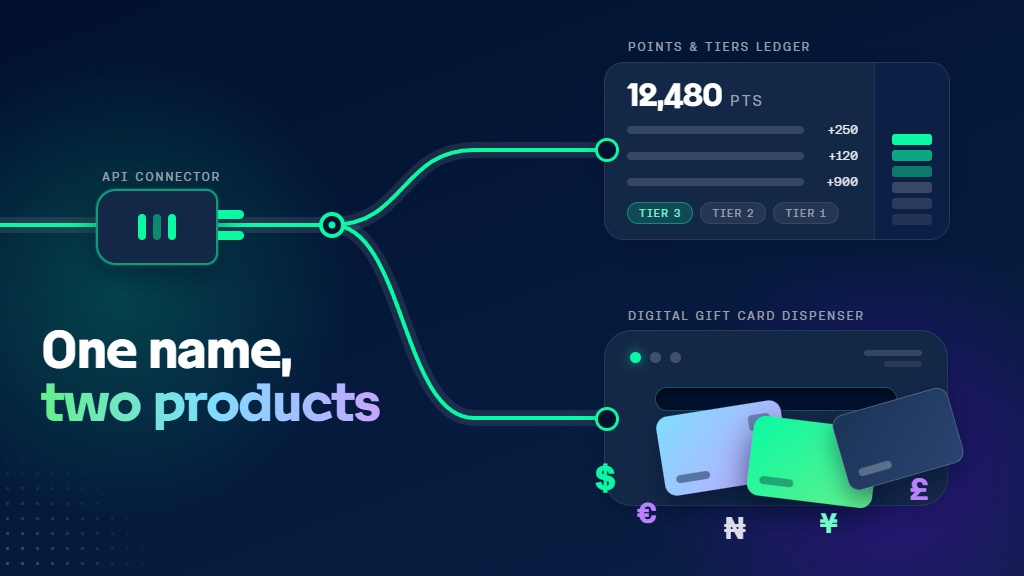
The phrase gets applied to two jobs that sit at opposite ends of the same program.
The first job is deciding. Who earned what, at which tier, under which promotion, and whether this particular redemption is allowed.
The second job is delivering. Turning an approved redemption into a gift card that arrives in the member’s inbox, in their country, in a currency the brand will actually settle.
The second job is where programs quietly leak. Antavo’s Global Customer Loyalty Report 2026, published in February 2026, found that 26.2% of loyalty points go unspent and a further 11.9% expire unused.
Antavo put the cost of that to US consumers at an estimated $10 billion a year in savings they had already earned.
Those are not points-maths problems. A member who cannot find a reward worth having, or cannot receive the one they picked, stops engaging long before the balance expires.
Why do loyalty program API searches return two different products?
Searches for a loyalty program API return two categories because the phrase covers both the layer that decides who earns a reward and the layer that delivers it.
Vendors on each side call themselves the loyalty API, and neither is wrong.
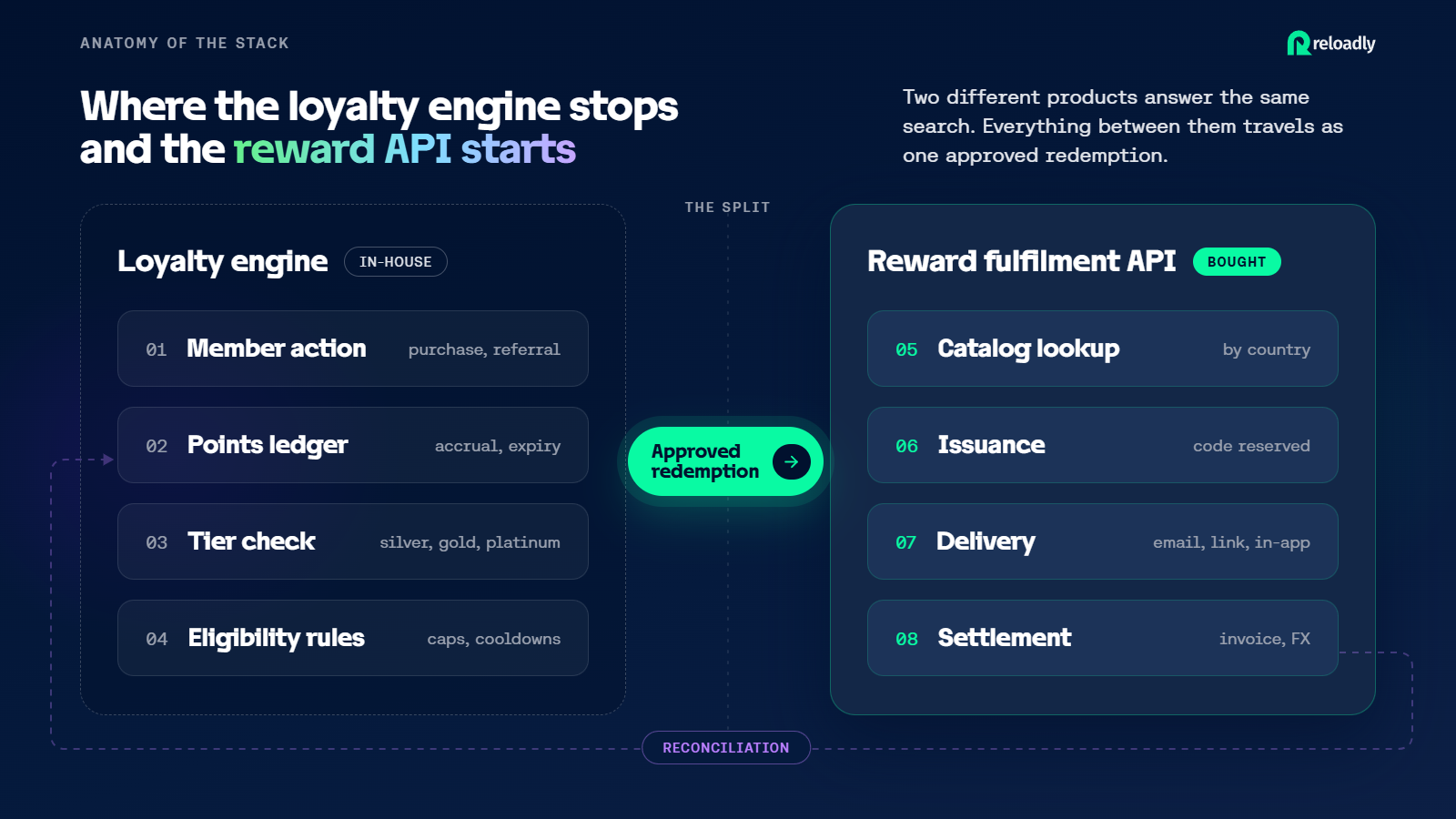
Loyalty engine. A loyalty engine is a rules platform that holds member records, points balances, tiers, earning rules and redemption eligibility. It decides who earned what, and whether a redemption is allowed.
Reward fulfilment API. A reward fulfilment API is an infrastructure service that turns an approved redemption into a delivered gift card, prepaid card or mobile top-up. It decides nothing, and it has to work every time.
| Loyalty engine | Reward fulfilment API | |
|---|---|---|
| Owns | Members, points, tiers, rules | Catalog, issuance, delivery, settlement |
| Answers | Who earned what, and can they redeem it | Did the reward arrive, and did it reconcile |
| Fails as | Wrong balance, wrong eligibility | Wrong country, failed order, unmatched payout |
| Usually | Built in-house or bought once | Bought, and swapped when it breaks |
Most organisations already own the first half. The Incentive Research Foundation’s Industry Outlook for 2026, published in December 2025, found that 84% of North American and 79% of European programs are managed internally.
That study covered 400 organisations across both regions, and it named the cost and complexity of external solutions as a reason programs stay in-house.
Those same programs still have to source rewards from somewhere, and gift cards are what they source. The IRF put gift cards at 30% of program allocations in North America and 34% in Europe, the most widely used reward type in both regions.
That is the shape of the market. The rules live in-house, and the rewards come from a provider like Reloadly’s gift card API.
Four criteria decide a reward fulfilment provider for a loyalty program: catalog depth in your members’ countries, country and currency coverage, delivery and reconciliation behaviour, and compliance and switching risk.
- Catalog depth. How many brands are actually issuable in the countries your members sit in, not how many exist in total.
- Country and currency coverage. Which brands are live per market, and which currencies the provider settles in.
- Delivery and reconciliation. Whether every delivery state is reported, retries are safe, and payouts match your ledger.
- Compliance and switching risk. How the provider handles regulation, and what leaving costs if you need to.
Each of these four is cheaper to test in a pilot than to discover in production.
How deep does a reward catalog need to be for a loyalty program?
Catalog depth is measured in what is actually issuable in your members’ countries, not in the total brand count on a provider’s homepage.
A catalog of 5,000 brands that can only issue 40 of them in Brazil is a catalog of 40 brands to a Brazilian member.
Ask for the issuable list by country before you sign anything. Then ask what happens when a brand goes out of stock mid-order, because that is the failure your support team will inherit.
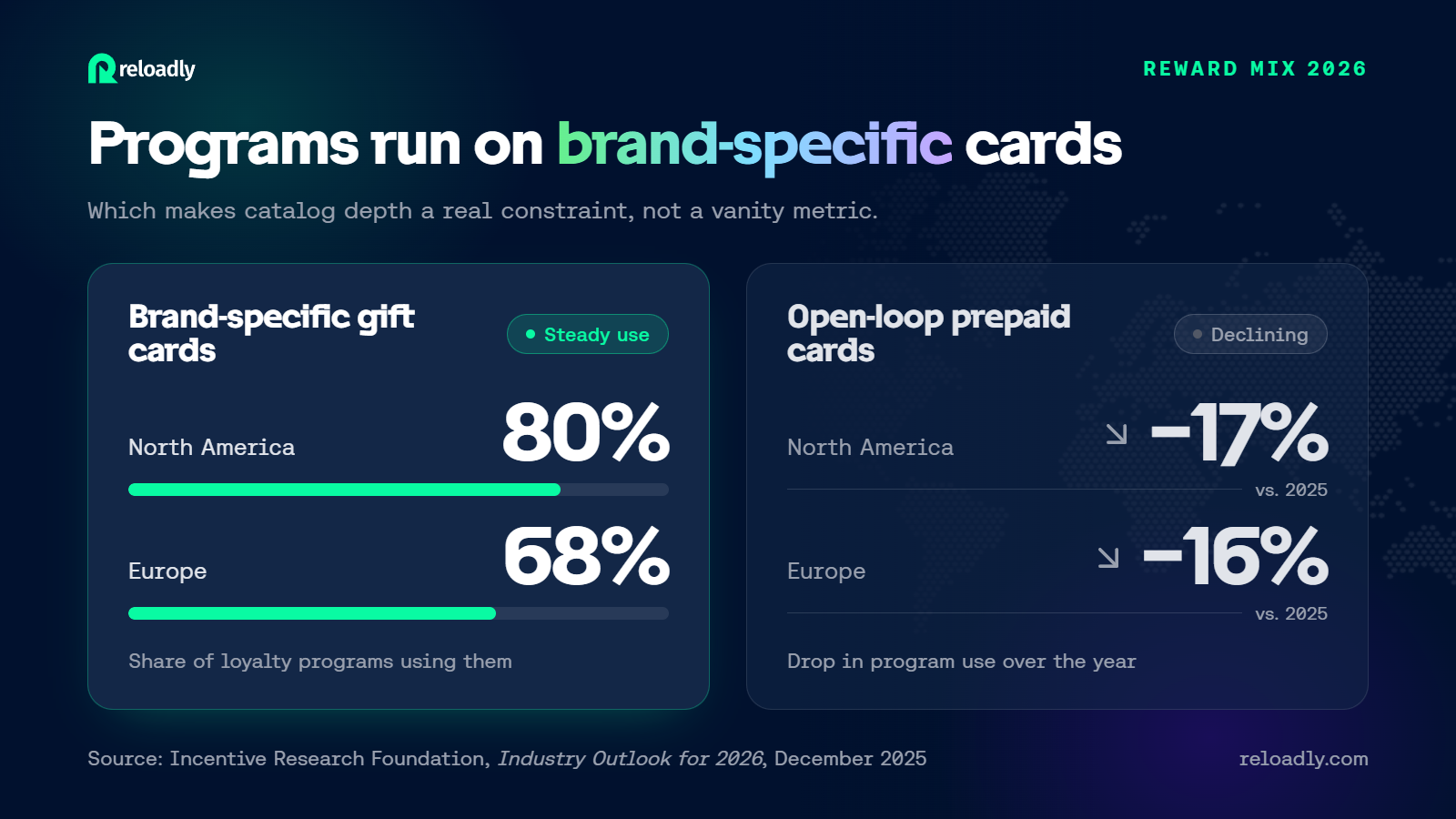
Brand-specific cards are what members want. The Incentive Research Foundation found brand-specific gift cards in steady use by 80% of North American programs and 68% of European programs.
They ran well ahead of open-loop prepaid cards, the Visa and Mastercard kind that spend anywhere, whose use declined 17% in North America over the year.
Relevance matters as much as volume. Antavo’s Global Customer Loyalty Report 2026 found that 38.9% of loyalty program members say the rewards available to them are simply not interesting, which is a catalog problem wearing a program-design costume.
The Reloadly gift card catalog covers 1,000+ brands and 14,000+ gift card products, and the number that counts is whichever slice of it reaches your members. Any provider should be able to give you that figure per market.
What country and currency coverage should a rewards API have?
Coverage is a per-country, per-brand, per-currency question, and a single headline number answers none of it.
Reloadly delivers into 150+ countries, framed as any country not under sanctions, and supports 100+ currencies. The useful question is which brands are live in the markets your members actually sit in.
Picture a rewards platform in São Paulo running a channel-partner program across Brazil, Mexico and the Philippines. A partner in Manila hits a milestone and picks a coffee brand from the catalog.
The order fails, because that brand is only issuable in the United States. Nothing was misconfigured. That provider’s catalog advertised 5,000 brands, and for that partner on that day it held zero.
Currency is the second half of the same problem. The member sees a value in pesos, the brand settles in dollars, and your finance team has one order living in two currencies.
That gap is where cross-currency reconciliation breaks, and it is worth understanding before it appears in a month-end close.
What delivery and reconciliation behaviour should you demand from a provider?
Delivery is a set of states, not a single call, and a provider that only reports success or failure has handed you a reconciliation problem.
Issued, delivered, opened, redeemed, failed and expired are each different, and each needs a webhook.
Idempotency is a property of an API that guarantees the same request sent twice produces one result rather than two. Test it hardest of all, because a retry storm that double-issues rewards is expensive and hard to unwind.
Reconciliation is where most programs are already struggling. Antavo’s Global Customer Loyalty Report 2026 found that 91% of loyalty program owners face challenges analysing the data their programs accumulate.
A fulfilment provider that returns unmatched payout records makes that worse rather than better. Ask for downloadable transaction records, balances, refunds and the treatment of unused rewards.
Ask how batch issuance is tracked when you submit thousands of rewards at once, which is a different operational shape from sending one. Reloadly covers both patterns in bulk gift card distribution and in gift card payout reconciliation.
How do you evaluate compliance and switching risk in a rewards provider?
Compliance and switching risk are evaluated by asking what a provider does when something goes wrong, and by asking what leaving costs before you sign.
Both questions are cheaper to ask during procurement than during an incident.
Regulation is a live problem for programs of every size. The Incentive Research Foundation found that 70% of programs in both North America and Europe face challenges simply staying informed about the regulations affecting them.
That makes a provider’s sanctions screening, business verification and data residency answers part of the evaluation rather than a footnote.
Switching cost is easy to leave until last. Catalogs are not portable, brand availability differs by provider, and a migration that changes which brands your members can pick is a program change rather than an integration change.
Reloadly covers what that migration involves in switching gift card providers.
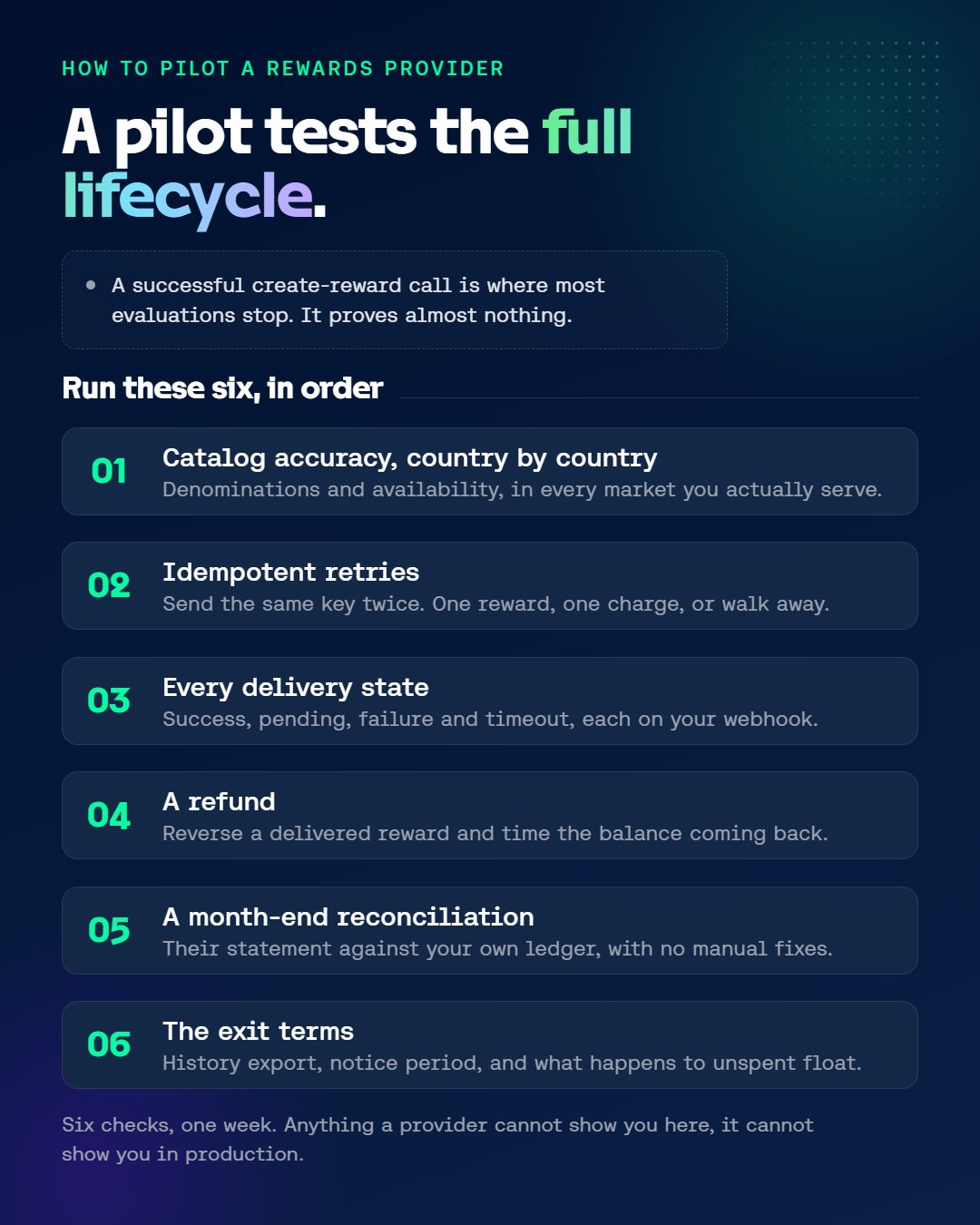
Run a pilot before committing. Test the full lifecycle, not a successful create-reward call: catalog accuracy by country, idempotent retries, every delivery state, a refund, and a month-end reconciliation against your own ledger.
Frequently asked questions about loyalty program APIs
Is a loyalty program API the same as a rewards API?
Not usually. A loyalty program API often means the engine holding points, tiers and earning rules. A rewards API, sometimes called a reward fulfilment API, delivers the gift card once a redemption is approved. Many programs run both, with the loyalty logic in-house and fulfilment bought in.
Which loyalty program API is best for gift card rewards at scale?
There is no single best one, because the question hides two products. If you already run points and tiers in-house, you are choosing a reward fulfilment provider, judged on catalog depth, country and currency coverage, delivery and reconciliation behaviour, and compliance and switching risk. If you need the rules engine too, that is a separate purchase.
Do you need a loyalty engine if you already have a rewards API?
Only if your earning and eligibility rules are complex enough to justify one. A points ledger, tier logic and promotion rules can live in your own application, and most programs keep them there. A rewards API does not replace that logic, and it should never become the system of record for a member’s balance.
Can a loyalty program deliver rewards under its own brand?
Yes. Swype Flex is Reloadly’s branded virtual prepaid card program, which lets a loyalty program issue cards carrying its own brand rather than a third party’s. It is the white-label option for programs that want the reward itself to reinforce the brand. Swype Flex cards are single-load today, meaning each card is funded once rather than topped up later.
What takes the longest in a rewards API integration?
Rarely the first API call. The work that stretches is catalog mapping by country, webhook handling for every delivery state, idempotency, and reconciliation into your finance systems. Budget for the reconciliation rather than the integration, and deployment runs under a master services agreement with the provider.
Ready to evaluate the fulfilment layer?
Reloadly runs the reward fulfilment layer for loyalty programs, marketplaces and rewards platforms that keep their loyalty logic in-house.
See how Reloadly marketing incentives work across the funnel, or talk to the team about your catalog, coverage and reconciliation requirements.