
Switching gift card providers goes wrong in two places: the contract you signed with the incumbent, and the catalog gap nobody mapped before cutover. A clean switch means auditing exclusivity and minimum-commitment clauses first, then testing the new provider’s brand, currency and denomination coverage against your actual sales mix before a single customer moves over.
What actually breaks when you switch gift card providers?
Most switching failures trace back to two decisions made before the migration ever starts: not reading the exit terms in the old contract, and not verifying the new provider actually carries what customers already buy.
A distributor selling Amazon and Uber gift cards to customers in Brazil, priced in reais, discovers mid-migration that the new provider settles those brands only in US dollars with no real-time FX conversion. Redemptions that used to clear in seconds now sit in a manual queue.
That is not a technical failure. It is a coverage gap that a side-by-side catalog comparison would have caught in an afternoon.
The two failure modes are contractual and operational, and they compound if you tackle them out of order. Signing with a new provider before confirming catalog parity means the gap surfaces only after customers already expect the old brand mix.
Confirming catalog parity before checking the exit clause has its own version of the same problem. You find out termination needs 90 days’ notice only after you have already told customers a switch date.
What should you check in the current vendor contract first?
Before evaluating any new provider, read the termination, exclusivity and minimum-commitment clauses in the contract you are trying to leave, because these determine your actual timeline and cost, not the new vendor’s onboarding pitch.
Two clauses account for most of the friction distributors report when they try to leave a gift card vendor.
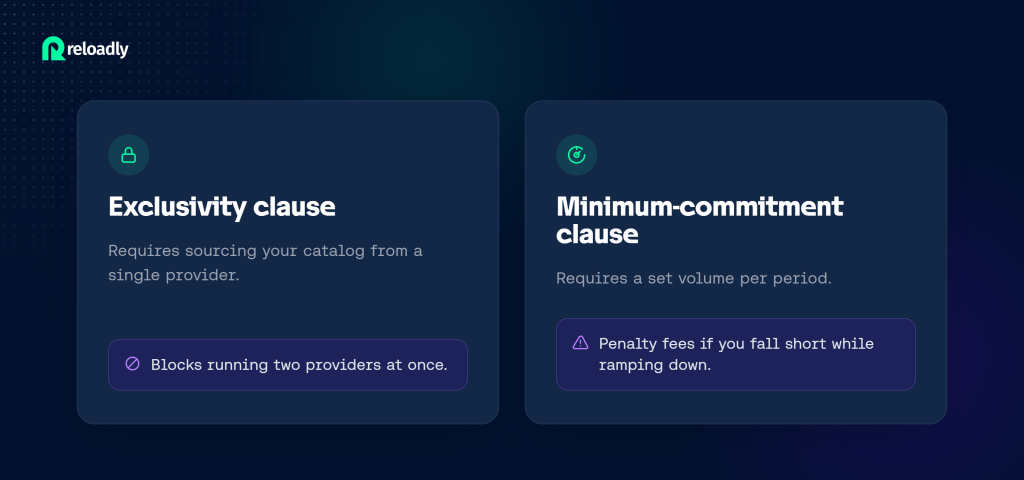
An exclusivity clause is a contract term that requires you to source all or most of your catalog from a single provider. In practice, it blocks running a second system in parallel during migration, since a dual-run would put you in breach the moment the new provider’s volume starts counting.
If your current agreement has one, a dual-run migration may not be contractually available to you. That matters, because a dual-run is otherwise the safest way to switch.
A minimum-commitment clause is a contract term that requires a set dollar volume or card count per period, with a penalty fee if you fall short. This matters most in the exact window when you are ramping down the old provider’s volume in favor of the new one. That ramp-down is precisely when you are most likely to miss the minimum.
Vendor lock-in has a measurable cost when contract exit isn’t planned for. GainHQ, a vendor-management research firm, cites data showing organizations without lock-in prevention planning face switching costs “16 times higher” than those with a plan in place (GainHQ, 2026).
That figure comes from cloud infrastructure contracts generally, not gift cards specifically. The mechanism still holds: switching cost is set mostly by what you failed to negotiate going in, not by what you negotiate on the way out.
How do you know the new provider covers your catalog?
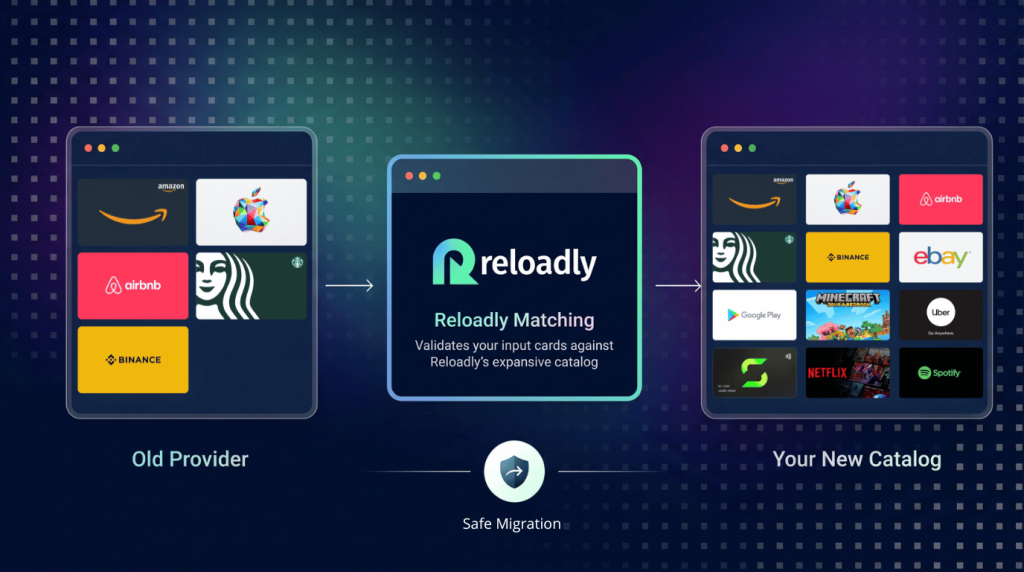
Request a sandbox catalog from the candidate provider and check it against your actual order history, not a marketing brand list, because published brand counts do not tell you whether the specific brands, currencies and denominations your customers buy are covered.
A brand count on a pricing page is not a coverage guarantee. Reloadly’s catalog, for comparison, spans 1,000+ brands and 14,000+ gift card products across 150 or more countries.
Even a catalog that size still needs to be checked against a specific customer base rather than assumed to cover it. The number that matters is not how large the catalog is. It is whether the ten or twenty brands responsible for most of your volume are on it, in the currencies and denominations you actually sell.
Run the comparison in three passes:
Brand and currency overlap. Pull your last two quarters of order data and check every brand, country and settlement currency against the candidate’s live catalog, not its marketing page. A provider can list “global coverage” while still settling certain brands only in a single currency.
Denomination and variable-value support. Some brands only sell in fixed increments; others support open, customer-chosen amounts. If your business relies on variable-value cards for a specific brand, confirm the new provider supports that exact configuration rather than a fixed-denomination equivalent.
Fulfillment behavior under load. A brand being “in the catalog” does not guarantee it is deliverable in real time during a demand spike. Ask the candidate provider directly what happens to an order for a brand that is temporarily out of stock, and get that answer in writing before cutover, not after the first customer complaint.
What does a safe migration actually look like?
A safe migration runs both providers in parallel for a defined window, moves a small, low-risk slice of volume first, and keeps a documented rollback path open until the new provider has proven itself on real orders, not sandbox tests.
Dual-running is the single highest-leverage step in this list, and it is the one an exclusivity clause can take off the table. If your current contract permits it, keep the incumbent live while the new provider handles a small share of real transactions.
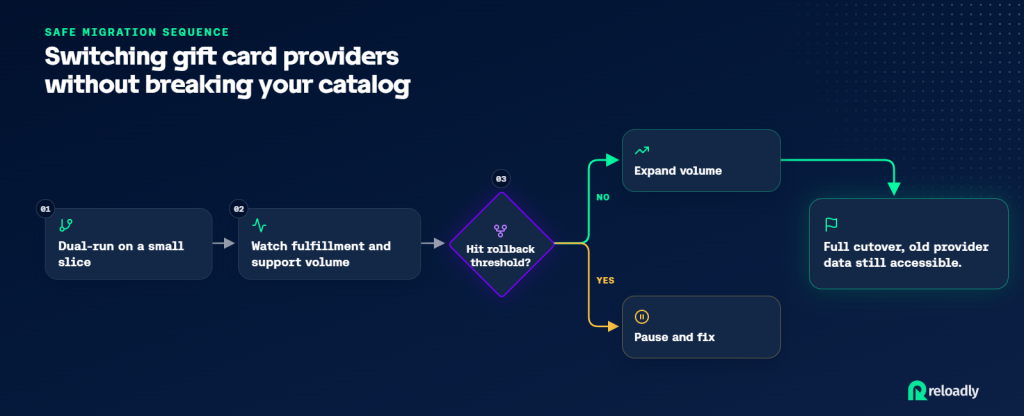
Start with one geography, brand set or customer segment at a time. Watch fulfillment success, redemption failures and support ticket volume on that slice before expanding it.
Set a rollback threshold before you start, not after something breaks. Decide in advance what failure rate, on what metric, triggers a pause. Without a number agreed beforehand, a live migration under pressure tends to keep running past the point where it should have stopped.
Keep the old provider’s data accessible through the transition, even after cutover. Refunds, disputes and reconciliation on orders placed before the switch do not stop the day volume moves to the new provider. Confirm in writing how long the incumbent will keep your transaction history queryable after the relationship ends.
Before-and-after: the naive switch versus the structured one
| Naive switch (before) | Structured switch (after) | |
|---|---|---|
| Contract review | Skipped or done after signing with the new provider | Exclusivity and minimum-commitment clauses read before any new contract is signed |
| Catalog check | Assumed from the provider’s marketing brand count | Verified against actual order history, brand by brand, currency by currency |
| Cutover | Single hard cutover on a fixed date | Dual-run on a small volume slice, expanded only after fulfillment holds up |
| Rollback | Decided reactively, mid-incident | Threshold and rollback path agreed before migration starts |
| Reconciliation | Old provider’s records assumed to disappear at cutover | Access to historical transaction data confirmed in writing past the cutover date |
Frequently asked questions
Can I run two gift card providers at the same time during a migration?
Only if your current contract does not contain an exclusivity clause. Exclusivity terms that require sourcing all or most of your catalog from one provider block a dual-run migration entirely, which is why reading the incumbent contract comes before evaluating any replacement.
What happens to my minimum-commitment obligations while I’m ramping down volume?
Minimum-commitment clauses typically still apply during a ramp-down, and penalty fees for missing the threshold do not usually pause because you are migrating away. Confirm the exact wording with your current provider before shifting significant volume to a competitor.
How do I check if a new provider’s catalog actually matches what my customers buy?
Request a live sandbox catalog and compare it against your last two quarters of order data, brand by brand and currency by currency, rather than relying on a published brand count. A large catalog can still miss the specific denominations or settlement currencies your existing customer base depends on.
Switching gift card providers without a plan for the contract you are leaving and the catalog you are moving into turns a vendor decision into an operational incident. Reloadly’s gift card API is built for distributors evaluating exactly this kind of move, with pricing structured around a global catalog rather than a single-market minimum.