

The best API for distributing bulk gift cards in a loyalty rewards program is one built for batch issuance, not single-card requests: it checks catalog availability before it commits, confirms delivery by webhook instead of by phone call, and reconciles payouts automatically instead of by spreadsheet. Reloadly’s Gift Card API is built around exactly that pattern.
Most teams don’t discover which parts of that pattern they’re missing until volume forces the question. The gap usually shows up first as a scenario like this one.
What Breaks When Gift Card Rewards Scale From Hundreds to Thousands?
A bulk gift card distribution API is the system that issues, confirms, and reconciles many gift card rewards from a single batch request, instead of one purchase at a time. A gift card program built around one-at-a-time requests usually works fine at low volume. It starts breaking as reward volume scales into the thousands, not because the API stops responding, but because the assumptions behind a small program stop holding.
Picture a gift card aggregator running a quarterly incentive payout. Four thousand field sales reps are splitting the reward, half in Brazil and half in the United States. At low volume, a coordinator can handle every odd case by hand.
At four thousand rewards, that coordinator becomes the bottleneck. A handful of reps get cards that were in stock yesterday and aren’t today, and a batch call times out partway through. Finance is waiting on a currency breakdown nobody has built yet.
A program built for one-at-a-time requests breaks when it’s asked to run at bulk, because catalog checks, batch handling, and reconciliation were never designed for volume. The fix isn’t a bigger team. It’s an API built around batch issuance, fallback logic, and reconciliation from the start.
How Does a Bulk Gift Card Distribution API Actually Work?
The same five-step sequence runs whether a batch issues ten cards or ten thousand. Reloadly’s Gift Card API is built around that pattern rather than adapted from a single-card checkout flow.
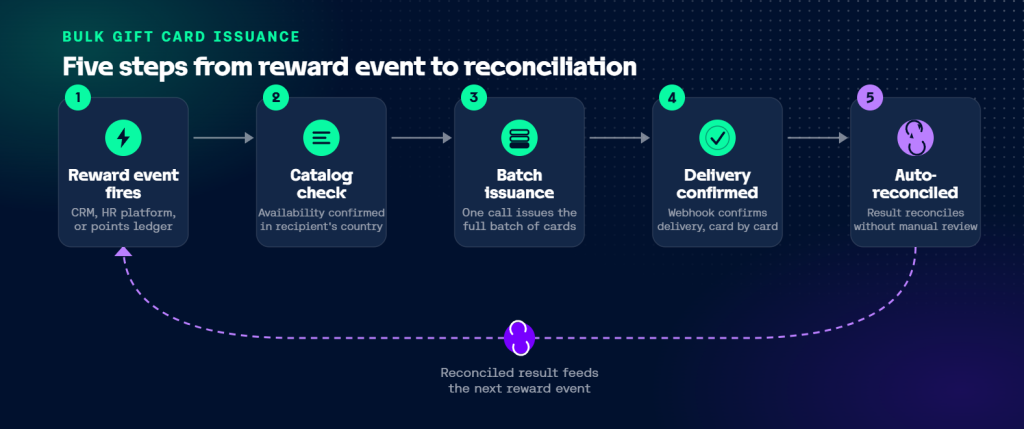
The workflow usually runs in five steps:
- A reward event fires, from a CRM, an HR system, or a points ledger, the moment a rep hits quota or a customer crosses a threshold.
- The API checks catalog availability for the requested brand and denomination in the recipient’s country before it commits to the order.
- Cards are issued in bulk, in a single call rather than a loop of individual purchase requests.
- A webhook, an automatic message the provider’s system sends the instant something happens, confirms delivery the moment each card issues. No one has to check a dashboard.
- The result reconciles automatically, tying every issued card back to the reward event that triggered it.
Corporate incentive programs are already moving in this direction. Mordor Intelligence’s 2026 analysis of the gift card and incentive card market found that more API-first platforms now plug directly into HR and CRM systems. Reward issuance triggers automatically when a milestone is hit. That cuts manual processing and speeds delivery at scale.
What Should Happen When a Brand Runs Out of Stock?
Reloadly’s Gift Card API checks stock before it issues a card, because a provider that only checks afterward has already failed the batch it was supposed to protect. That fallback logic has to run in real time, not after a rep reports a code that doesn’t work.
Reloadly’s catalog covers more than 150 countries with over 1,000 brands and 14,000-plus gift card products, which gives a batch request room to substitute a comparable brand automatically when the first choice is unavailable, rather than stalling the whole payout.
The decision logic itself is simple enough to state in a table:
| If… | Then… |
|---|---|
| The requested brand is out of stock in the recipient’s country | Substitute a pre-approved comparable brand at the same denomination |
| A batch partially fails (some cards issue, some don’t) | Reissue only the failed portion, using the same idempotency key so nothing doubles up |
| The payout currency differs from the settlement currency | Convert and log the rate at the moment of issuance, not at month-end |
| No webhook confirmation arrives within the expected window | Query the order status directly rather than assuming failure and reissuing |
That second row depends on a detail most teams get wrong the first time. An API needs a way to know a retried request is the same request, not a new one.
Stripe’s idempotency key documentation describes the underlying pattern: a unique key generated by the client lets the server recognize and deduplicate retries, so the same reward never issues twice.
How Do Teams Reconcile Bulk Rewards Across Currencies?
Reconciliation breaks down for the same reason issuance does: a process built for a handful of transactions a month gets asked to handle thousands, across multiple currencies, without anyone redesigning it. That’s exactly the failure mode the payments industry is already measuring outside of gift cards specifically.
Kani Payments’ 2025 Reconciliation and Reporting Survey polled 250 UK payments and banking businesses. Fifty-six percent still rely on spreadsheets for reconciliation.
Accurate data matching breaks down specifically around cross-currency transactions, multiple payment channels, and high transaction volumes. A bulk, international gift card program produces all three at once.
If cross-currency reconciliation is already a pain point at lower volume, Reloadly’s breakdown of why gift card payout reconciliation breaks across currencies covers the mechanics outside of bulk-specific failure modes.
A bulk API avoids the worst of it by tying reconciliation to the same webhook confirmation that closes out issuance. A finance team matches structured records instead of rebuilding the link from a spreadsheet export after the fact.
What Data Should Reconciliation Actually Include?
A reconciliation-ready webhook carries enough detail that a finance system never has to ask a follow-up question. Five fields should travel with every issued reward:
- The order or transaction ID
- The currency the card was issued in
- The exchange rate, if a conversion happened
- The country and brand of the card
- A reference back to the reward event that triggered it
Miss any one of those fields and the gap gets filled by someone opening a support ticket or rebuilding the record from a CSV, which is the exact manual step a bulk API exists to remove. This is also where a split-currency payout resolves cleanly: field reps in Brazil get cards priced and reconciled in reais, reps in the United States get cards priced and reconciled in dollars, and finance sees both sides of that conversion without asking either team to explain it by hand.
What Should a Partnerships Team Look For Before Integrating?
A partnerships or business development lead evaluating this kind of integration isn’t assessing code quality. They’re assessing whether the provider’s catalog, delivery guarantees, and reporting will hold up once the program is running at real volume. A few questions surface the answer faster than a feature list does.
Ask whether the catalog is deep enough for the countries the program actually serves, not just the ones in the demo. Ask how a partial batch failure is handled and reported, since that’s where manual work quietly creeps back in. Ask whether reconciliation data arrives in the format finance already uses, rather than a format the integration team has to translate by hand every month.
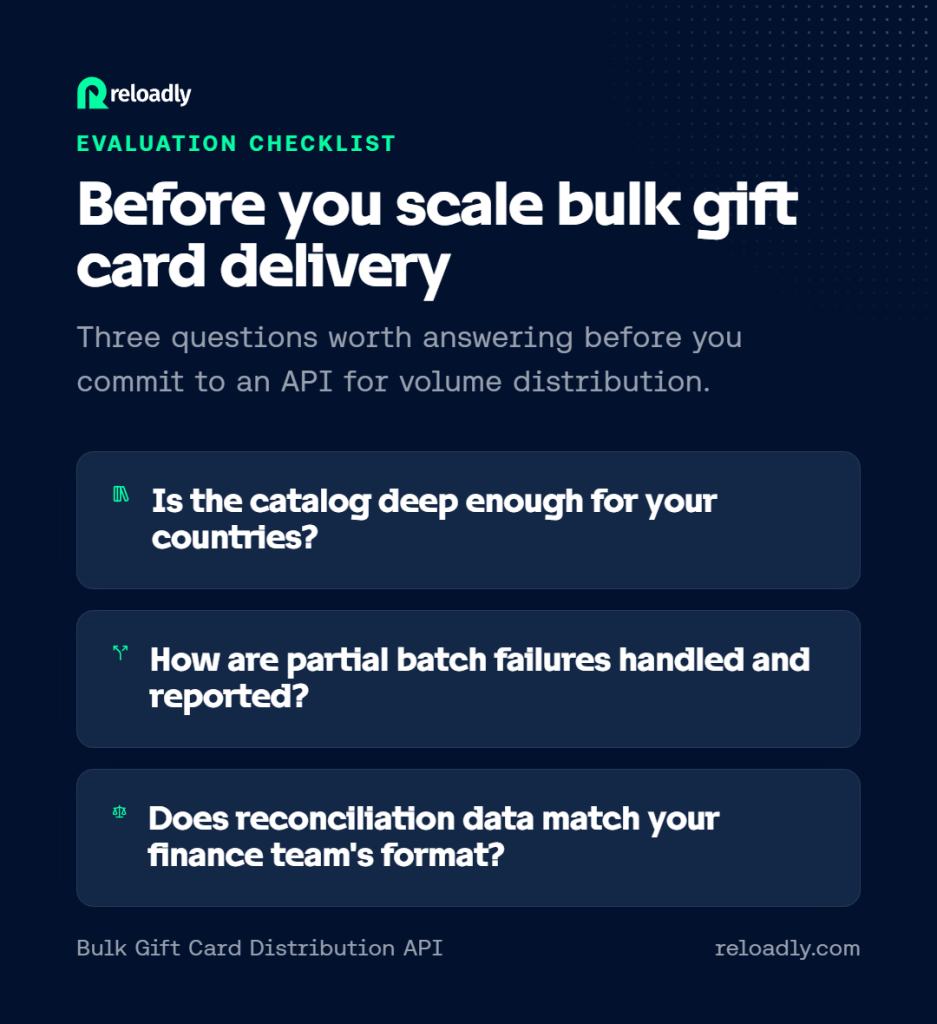
None of these questions require a technical background to ask, and none of them have a good answer from a provider that has only ever handled single-card requests.
Ready to see it running against a real catalog? Request Reloadly Gift Card API access and bring your own country list and volume.