
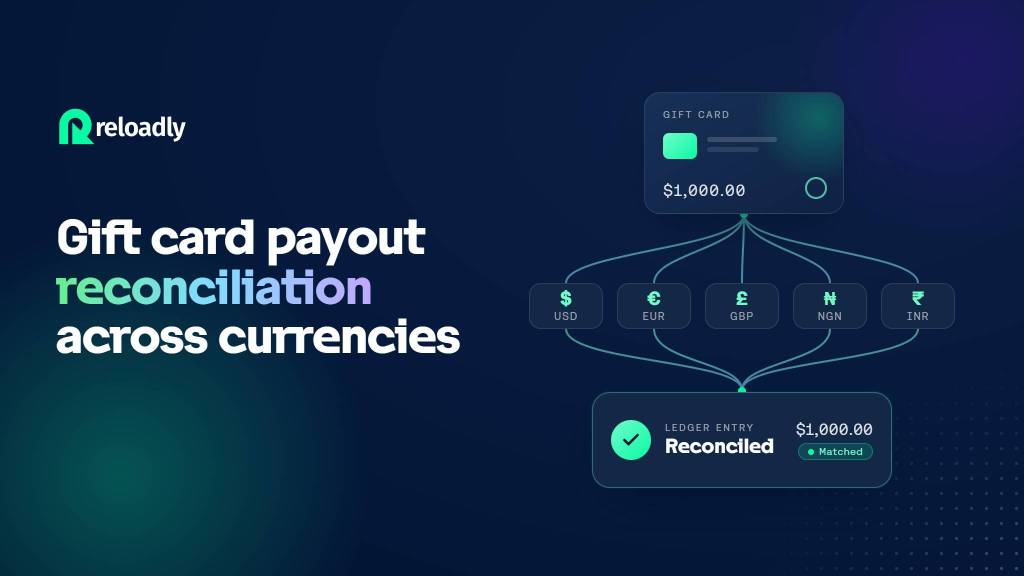
Gift card payout reconciliation breaks across currencies when the currency a card is sold in doesn’t match the currency the issuing brand settles in. Reloadly closes that gap by tracking presentment currency, settlement currency, and the exchange rate at every step.
Every order matches to a payout without a manual spreadsheet reconciliation.
What are presentment and settlement currency?
Reloadly is a gift card API that lets distributors issue, deliver and reconcile gift card payouts against a global brand catalog.
Reconciliation across currencies comes down to two terms, and most of the trouble starts with treating them as one.
Presentment currency is the currency a customer sees and pays in at the point of sale. Settlement currency is the currency the distributor actually receives once the transaction clears.
On a single order, those two are often different. Say you’re selling in Brazil. Your customer pays in reais, and the brand behind the card settles with you in US dollars.
Nothing has gone wrong at this point. But you now have one order living in two currencies, and only one of them is the currency your books are kept in.
Stripe’s supported currencies documentation describes this gap as normal for any business selling across borders, not a defect in the system.
For a gift card distributor, it shows up twice: once between the buyer and the distributor at the point of sale, and again between the distributor and the brand or issuer settling the card’s face value.
Reconciliation has to track both legs, or the books stop matching the moment a card crosses a currency line.
Why do gift card payouts break across currencies?
Three mechanisms break a reconciliation process that was built for a single currency: settlement lag, bank account coverage, and scale.
Settlement lag. A regular e-commerce sale settles within days. A gift card can sit unredeemed for weeks or months, so the exchange rate at issuance and the rate at settlement are rarely the same rate.
Reconciliation has to record both and account for the difference, or a gap opens between what the ledger expects and what actually clears.
This one is specific to gift cards. A distributor’s finance team is reconciling against a rate that may no longer exist by the time a card is redeemed.
Picture a card sold in Mexico against a catalog priced in US dollars. The buyer pays in pesos on day one. The brand behind the card doesn’t settle with the distributor until the card is redeemed, on day forty-five. Between those two dates, the peso can move several percentage points against the dollar.
Without a locked rate and a record of both currencies at both points in time, you can’t tell whether a discrepancy on redemption day is a currency shift, a pricing error, or a payout that never arrived. Three very different problems, one identical symptom.
Bank account coverage. A distributor can’t always hold a balance in every currency it sells in, so some conversions happen automatically at the payment processor or bank level rather than by choice.
Scale. A distributor running a handful of markets can reconcile currency mismatches by hand. One running dozens cannot, because the number of currency pairs to track grows faster than transaction volume does.
How does Reloadly reconcile cross-currency orders?
When a gift card sale and its settlement land in different currencies, Reloadly’s gift card API handles the match as a five-step process, from order to matched payout.
If you want the wider picture of what a gift card API covers beyond reconciliation, start there and come back. The five steps below are the reconciliation path specifically.
- Order capture. The API records the order in its presentment currency, the currency the end customer or recipient sees, along with the exact timestamp.
- Rate lock. Reloadly locks the exchange rate that governs the order at the point of capture, so the rate used for reconciliation is fixed and auditable rather than floating.
- Fulfillment. The gift card is issued from Reloadly’s catalog and delivered to the recipient, with the order ID carried through as the reference for every step that follows.
- Issuer settlement. The brand or issuer behind the gift card settles in its own settlement currency, which may not match the presentment currency from step one.
- Reconciliation match. Reloadly matches the original order, the locked rate and the settlement record against each other by order ID, so a finance team can see exactly which orders are settled, which are pending, and which show a rate difference.
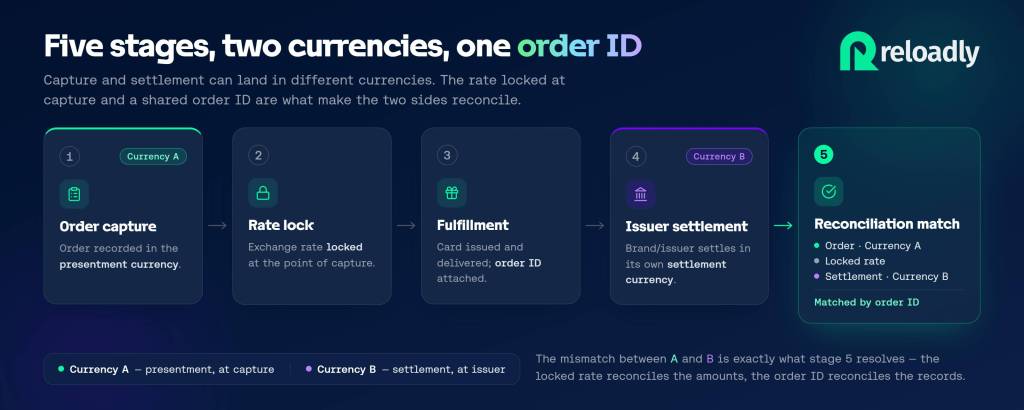
That fifth step is what a distributor loses when reconciliation runs by hand across spreadsheets pulled from separate systems. A single reference point ties a sale in one currency to a settlement in another. Without it, matching is a lookup, and every lookup is a person.
Where does FX gain or loss get recorded?
Reloadly locks an exchange rate at the moment a gift card order is captured, and books the difference between that rate and the rate available when funds actually move as a foreign exchange gain or loss, separate from the product revenue on the order.
A locked rate doesn’t make that difference disappear. It makes it identifiable, which is the part that matters.
Keeping FX separate from product revenue is what lets a finance team tell a margin problem from a currency problem. Blend them into one number and a bad quarter has no diagnosis, only a total.
A distributor operating in volatile markets needs that clean FX line to know whether the quarter went wrong in the product or in the market. Those two findings lead to completely different decisions.
Reloadly reports this at the order level. The FX line and the product line stay separate throughout, from the transaction record to the payout report the finance team reconciles against.
How many countries and currencies does this cover?
Reloadly’s gift card API operates in 150+ countries, framed as any country not under sanctions, and settles across 100+ currencies.
The number worth paying attention to isn’t the country count. It’s that the currency pairs you have to reconcile grow with every market you enter, not with every customer you add.
A distributor entering a new market through Reloadly is adding one connection to a reconciliation system that already exists, rather than building a new one.
That distinction matters most if you’re weighing whether to build multi-currency reconciliation in-house. Ten markets means up to ten currency pairs tracked by hand. At the coverage above, the manual approach stops being viable long before the market count gets there.
What to check before switching API providers?
A reconciliation problem is usually the first sign that a distributor has outgrown its current provider, not a reason to avoid switching.
Before making that move, a distributor evaluating a new gift card API should check three mechanisms: rate-lock timing, FX reporting separation, and reference-ID continuity. Each one carries a distinct operational cost when it’s missing, and none of them is visible in a demo.
| If the provider… | Then… |
|---|---|
| Only locks the exchange rate at settlement, not at order capture | Every disputed order requires finance to manually re-derive the applicable rate |
| Blends FX gain or loss into product revenue | Product margin and currency movement get debated together instead of diagnosed separately |
| Doesn’t carry a single reference ID from sale through settlement | Matching a sale to a settlement means a manual lookup across two systems, repeated for every order that doesn’t reconcile automatically |
| Locks the rate at capture, separates FX reporting, and carries one reference ID end to end | Reconciliation matches automatically, and exceptions are the only manual work left |
Reloadly’s API meets the fourth condition today, across its full country and currency coverage.
Worth asking a prospective provider all three questions before you migrate, because the answers are cheap to get now and expensive to discover later.